Colophon
What is this thing?
You can describe this digital resource with a number of terms:
- a digital garden
- a riff on a blog
- a very small, very niche wiki
- a 21st-century commonplace book
- a website
How would one make a website like this?
For years, I have been an avid user of the free note-taking software Obsidian. I use it to organize my thoughts, to learn new skills, and even to do score study when I find a new piece that I want to dig into.
I’ve used Obsidian to give a slideshow presentation, to inventory moving boxes, and to make websites like this one you’re reading now! All of this is to say that Obsidian is very powerful and flexible software.
You can transform your Obsidian notes into a public website using a neat website/blog framework called Jekyll. There’s a custom website template for doing this which I have used for three or four years now and really like. There’s a full tutorial on how to do this, but the gist is that you can turn your notes into a Github repo and every time you push your repo, the website gets updated automatically. (This website is hosted through Netlify).
Why would one want to do that?
There are a few reasons why I think this format can be useful for analysis (or for writing about music more generally).
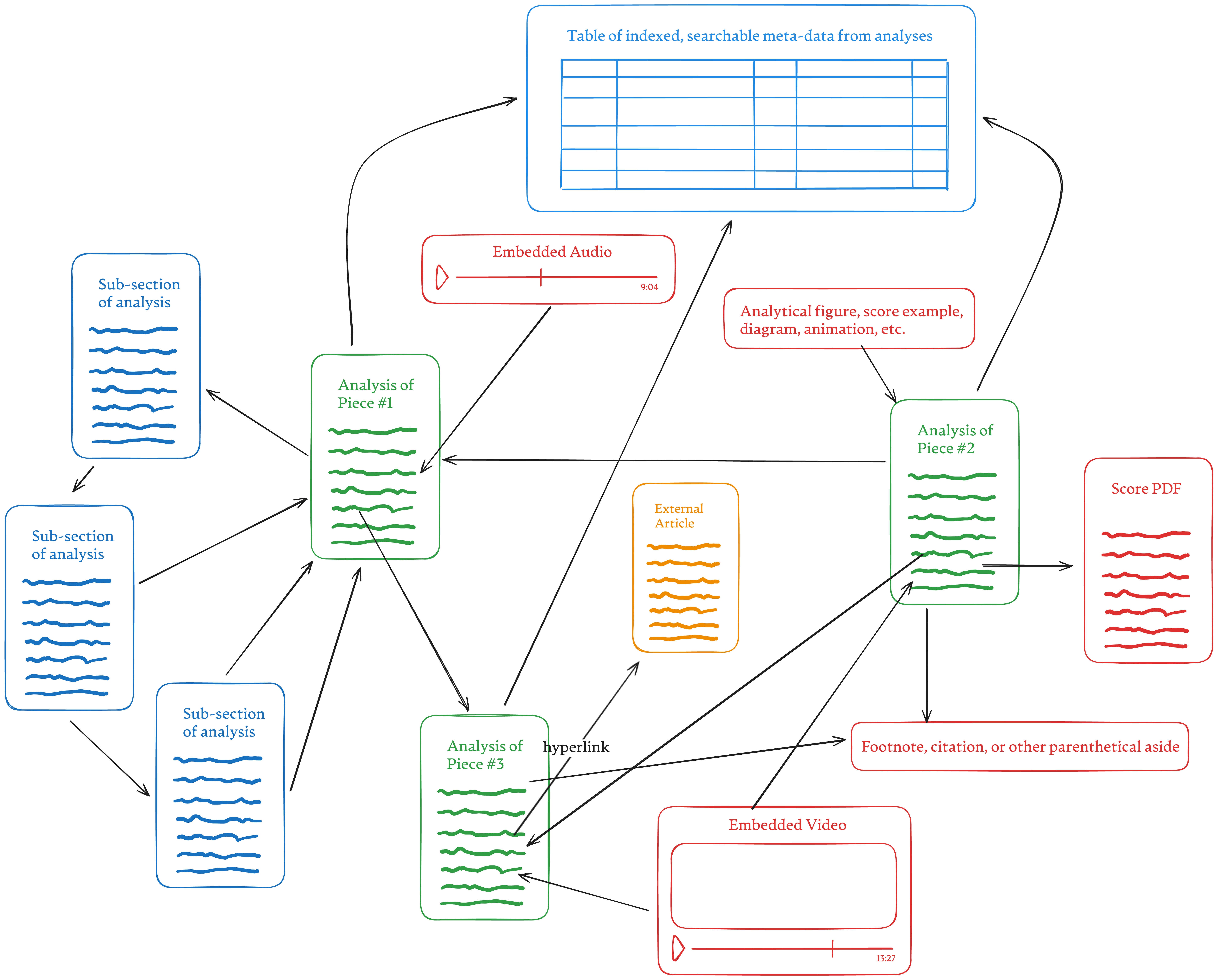
- It’s easy to incorporate hyperlinks, cross-references to other notes, footnotes 1, and all sorts of media right in the middle of your analysis or discussion.
- Traditional analytical papers are linear works that depend on a certain type of straightforward reading. I sometimes prefer to allow my ideas to accrue and form rhizomatic structures rather than stricter hierarchies or outlines. I also imagine that some readers may want to unpack an analysis of a work or a discussion of music in a “non-linear”, choose-your-own-adventure fashion.
- This medium is more flexible than an analytical paper – portions of the text can be easily updated, cross-referenced, embedded, augmented, expanded, or refactored in any number of ways. And if I want or need to generate a paper from these notes, that option is also open to me! (There are even more advanced and flexible ways of accomplishing similar goals, but this option suffices for this project).
- Notes collected in Obsidian can be as formal or informal as desired. In creating a website like this, I feel like I am first and foremost interfacing with my ideas in a familiar note-taking environment. The website that you’re viewing is just a handy by-product of that work. This means that Obsidian is quite well-suited to a more thoughtful and nuanced version of “learning in public.” You can read an illuminating critique and correction of the social media learning in public hype at Maggie Delano’s website. (Note that she has her own digital garden!)
- Additionally, any changes only have to be made once in Obsidian – no tracking through multiple files or version numbers. (On the flip side, versions of the digital garden are automatically saved through Git, so it is easy to recover previous versions of the notes/website if anything needs to be reverted).
- This is not to mention the fact that a website like this can host a whole range of analyses and essays that can be put into conversation with each other. (Furthermore, the Obsidian app has powerful tools for searching, indexing, tabulating, and adding metadata fields to notes – this makes it a powerful environment for developing new insights and connections across ideas and topics). In short: intertextuality! In the early days of a growing digital garden, it might look something like this:
-
See how easy that was! (By the way, here’s a definition of what a colophon is). ↩